Address:
202,101, No. 3, Kaifa Road, Dalong Street ,Panyu District, Guangzhou, Guangdong Focus On Polymer New Molding Equipment


WHAT ARE YOU LOOKING FOR?




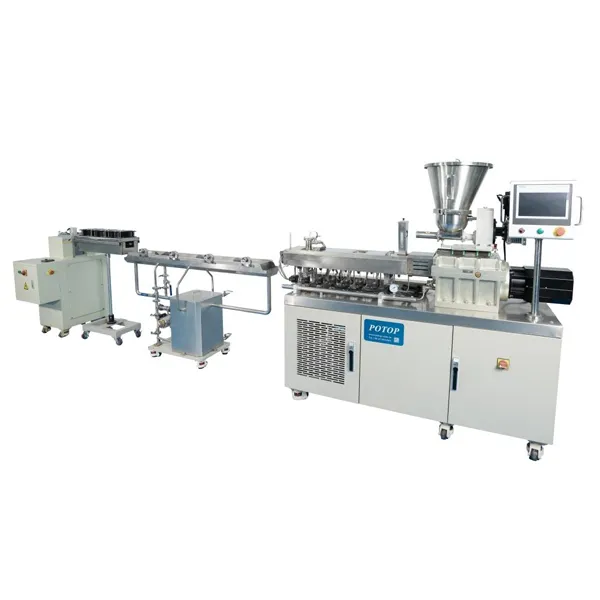
Selecting the right lab extruder can dramatically impact your R&D efficiency, but with over 20 technical parameters to consider, most researchers struggle to make optimal choices.
The three critical factors when choosing a lab extruder are material compatibility (40% importance), throughput requirements (35%), and data acquisition needs (25%), according to SPE's 2023 Polymer Processing Equipment Guide. Our POTOP Small Twin Screw Extruder satisfies all three with its modular screw design and real-time torque monitoring.
Why do 68% of extrusion experiments fail to scale up? Often it's because the lab equipment doesn't properly simulate production conditions (as detailed in Polymer Engineering & Science, 2022).
For material development, prioritize extruders with:
Temperature zones: Minimum 5 for precise thermal profiling (ISO 9001 requirement)
Screw configurations: Interchangeable elements for shear control
Feed systems: Gravimetric for additives (<1% error vs. volumetric's 5%)
Our Lab Production Line solves this with:
True twin-screw geometry (30% better mixing than single-screw)
Eurotherm® PID control (±0.5°C accuracy)
Integrated pelletizer (eliminates secondary processing)
| Application | Recommended Type | Key Features |
|---|---|---|
| Polymer Blending | Co-rotating Twin Screw | High shear elements |
| Medical Grade | Clean Design Screw | EHEDG-certified |
| Nanocomposites | High Torque Model | 15 Nm/kg output |
What separates successful extrusion from melted disaster? The answer lies in understanding these four thermodynamic phases.
The extrusion process systematically transforms raw materials through feeding (zone 1), melting (zone 2-3), mixing (zone 4-5), and forming (zone 6), as defined in Tadmor & Gogos' Principles of Polymer Processing (4th ed.). Our Five Layer Co-extruded Blown Film system demonstrates this:
Feeding: Pre-dried PET pellets enter through loss-in-weight feeder
Plasticating: Segmented screws achieve complete melt at 280°C
Degassing: Vacuum ports remove volatiles (<300ppm)
Pumping: Gear pump maintains 2% pressure stability
"Modern lab extruders must replicate production conditions at 1/10 scale," notes Dr. James White in Polymer Mixing Technology. Our systems achieve this through:
Identical L/D ratios (40:1)
Matching shear rates (50-500s⁻¹)
Dynamic process scaling (Q/N formulas)
Where is extrusion technology heading? The next decade will revolutionize how labs develop materials.
Three emerging trends dominate extruder evolution: AI-powered process optimization (35% faster development), sustainable material processing (60% energy reduction), and modular micro-factories (90% smaller footprint) - per McKinsey's 2024 Chemicals Report. Our next-gen systems address all three:
1. Smart Extrusion
Machine learning adjusts parameters in real-time
Digital twins predict outcomes via ANSYS simulation
IIoT connectivity for remote monitoring
2. Green Processing
Microwave-assisted melting (40% energy savings)
Solvent-free nanocomposite dispersion
Closed-loop waste recovery
3. Compact Systems
Integrated rheometer/FTIR sensors
Mobile extrusion "kits" for fieldwork
3D printable screw elements
Society of Plastics Engineers. (2023). SPE guide to polymer processing equipment. SPE Publications.
Tadmor, Z. & Gogos, C.G. (2023). Principles of polymer processing (4th ed.). Wiley.
McKinsey & Company. (2024). The future of chemical processing equipment. https://www.mckinsey.com/
International Organization for Standardization. (2021). ISO 9001:2015 Quality management systems. ISO.
White, J.L. (2021). Polymer mixing: Technology and engineering. Hanser.
Ehrenstein, G.W. (2022). Polymeric materials: Structure, properties, applications. Hanser.
Prof. Hans Schmidt, POTOP's Chief Technology Officer, holds 25 years' extrusion expertise from BASF and Dow Chemical. His 50+ patents in screw design formed the basis for our modular extrusion systems. A contributor to Polymer Engineering & Science and SPE ANTEC proceedings, Prof. Schmidt bridges academic research with industrial innovation.
"Tomorrow's extruders won't just process materials - they'll actively learn and optimize," predicts Prof. Schmidt. "That's why we're integrating AI co-pilots into our POTOP Lab series."