Address:
202,101, No. 3, Kaifa Road, Dalong Street ,Panyu District, Guangzhou, Guangdong Focus On Polymer New Molding Equipment


WHAT ARE YOU LOOKING FOR?


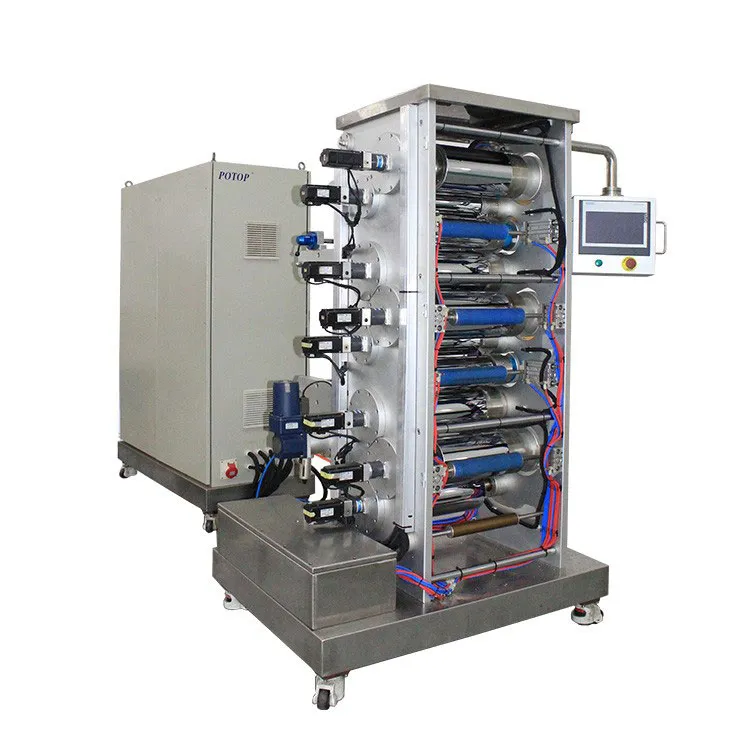


In laboratory environments, biaxially oriented stretching (also known as biaxial stretching) of thin films is a key polymer material processing technique. Its main function is to stretch the film in both longitudinal (MD) and transverse (TD) directions, aligning the polymer chains along the plane of the film and significantly improving its overall performance.
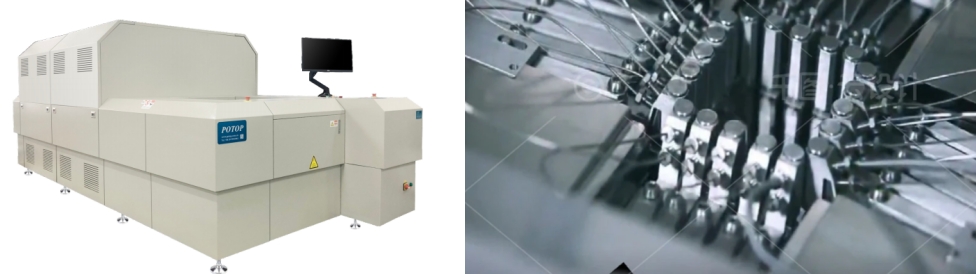
Improving mechanical performance: Bi directional stretching of the biaxial tensile tester significantly enhances the tensile strength, tear resistance, impact resistance, and toughness of the film in both longitudinal and transverse directions, resulting in a more balanced performance compared to uniaxial stretching
Improving barrier performance: The molecular chains are arranged more tightly in a backward direction, effectively reducing the transmission rate of water vapor, oxygen, and odors. It is suitable for high demand packaging such as food and medicine
Optimize optical performance: increase transparency and glossiness of the film, reduce haze, and achieve better visual effects
Enhanced dimensional and thermal stability: After heat setting, the film has low shrinkage and deformation in high or low temperature environments, and can be used stably in a wide temperature range (such as -70 ℃ to 150 ℃)
Improve thickness uniformity and surface quality: Especially synchronous biaxial stretching process can achieve more uniform thickness distribution and smoother surface
Support functional film development: can be used to prepare high-end materials such as optical films, battery separators, capacitor films, medical EPTFE films, etc
Packaging industry: BOPP (food, cigarettes), BOPET (electronic, cooking packaging), BOPA (frozen, vacuum packaging)
Electronic and Electrical Engineering: Flexible Circuit Boards, Capacitor Films, Insulation Materials
New energy: lithium battery separator, energy storage capacitor film
Medical and specialty materials: high-performance medical expanded polytetrafluoroethylene (ePTFE) membrane
Agriculture and Construction: Greenhouse Membrane, Waterproof Membrane
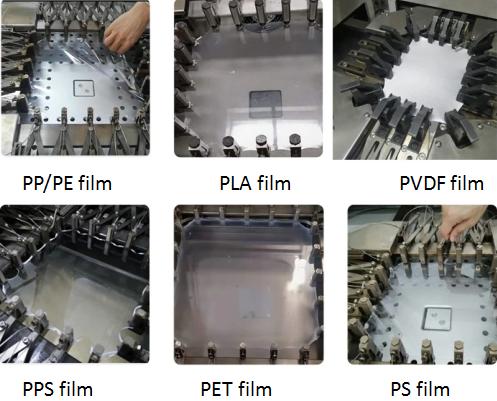
Raw material pretreatment: Moisture absorbing polymers (such as PET, PA) need to be dried to a moisture content of<50 ppm to prevent melting and hydrolysis
Stretching method
Asynchronous stretching: First vertically and then horizontally, the equipment is mature, but it may produce a "bow effect"
Synchronous stretching: simultaneous stretching in both longitudinal and transverse directions, resulting in more balanced film performance and better optical and surface quality
Key parameters: stretching temperature (usually above Tg and below Tm), stretching ratio (PP can reach 35-55 times), heat setting conditions
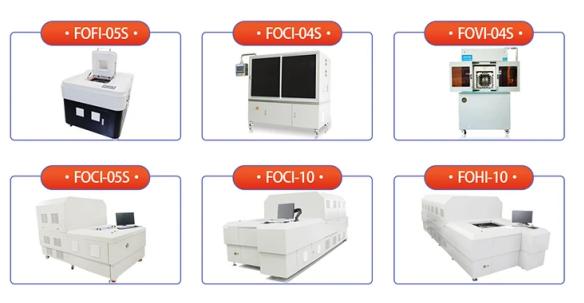
In the laboratory, biaxial stretching is commonly used for the study of polymer material properties, the development of new membrane formulations, and process optimization. It is an important bridge connecting basic research and industrial applications
For more detailed information about the device, please log in to the website: https://potoptech.en.alibaba.com/ Contact: Layla, Phone: 0086 13424024189, WhatsApp Sync. We look forward to hearing from you.