
Address:
202,101, No. 3, Kaifa Road, Dalong Street ,Panyu District, Guangzhou, Guangdong Focus On Polymer New Molding Equipment


WHAT ARE YOU LOOKING FOR?




Plastic sheet extrusion lines are used to manufacture rigid and semi-rigid sheets for packaging, thermoforming, automotive components, construction products, appliance panels, optical applications, solar materials and laboratory research. Although these systems share the same basic process of melting a polymer and forming it through a flat die, their technical configurations vary significantly. A compact laboratory sheet extruder may be designed to produce 150 mm-wide samples for formulation testing. A commercial production line, by comparison, may combine multiple extruders, a coextrusion feedblock, an automatic flat die, a polishing stack, thickness measurement, edge trimming, recycling and automated winding or stacking. This difference makes it difficult to compare plastic sheet extrusion machine manufacturers solely by company size or maximum output. The correct supplier depends on the material, sheet thickness, product width, number of layers, surface requirements, production capacity and intended application.
This article introduces ten manufacturers with identifiable plastic sheet extrusion equipment. The list covers laboratory machines, pilot systems and industrial production lines so that research organizations and manufacturing companies can identify suppliers that fit their actual project scale.
The companies were selected using product information published on their official websites and in their technical materials. Each manufacturer offers an identifiable sheet extrusion machine, sheet line or flat extrusion system rather than only supplying individual screws, dies or auxiliary equipment.
The evaluation considered the scale of equipment available, supported polymers, mono-layer and coextrusion capabilities, sheet-forming technology, process control, downstream integration and the industries served. The list is intended as a practical starting point for technical and commercial evaluation, not as an absolute performance ranking.
POTOP publishes this article and appears first because its laboratory sheet extrusion equipment is directly relevant to the research and development audience of this website. The other manufacturers are presented according to their product focus rather than a numerical performance score.
| Manufacturer | Country | Main Equipment Scale | Main Sheet Applications | Suitable Project Type |
|---|---|---|---|---|
| POTOP | China | Laboratory and pilot | Polymer samples, process development and material evaluation | R&D and small-scale trials |
| BREYER | Germany | Pilot and industrial | Optical, transparent and technical sheet | High-quality specialty sheet |
| SML | Austria | Industrial | PP, PS and barrier thermoforming sheet | Packaging-sheet production |
| Davis-Standard | United States | Laboratory to industrial | Packaging, automotive, medical and heavy-gauge sheet | Customized production lines |
| Gneuss | Germany | Pilot and industrial | PET and recycled PET thermoforming sheet | Direct recycling-to-sheet projects |
| Reifenhäuser | Germany | Industrial | PP, PS, PET and barrier sheet | High-output thermoforming sheet |
| KraussMaffei | Germany | Pilot and industrial | Flat sheet, plate and technical products | Process-specific industrial extrusion |
| OMIPA | Italy | Industrial | Optical, technical, thermoforming and hollow sheet | Customized sheet and panel lines |
| JWELL | China | Industrial | PET, PP, PS, PVC, ABS and other sheet products | Broad commercial production |
| USEON | China | Pilot and industrial | Direct sheet extrusion and filled compounds | Compounding-to-sheet processes |
POTOP is a Chinese manufacturer of laboratory and pilot-scale polymer processing equipment. Its product range includes extrusion, casting, blown film, stretching, compounding, pelletizing and rheology-testing systems. In the sheet extrusion category, the company focuses primarily on material research and process development rather than high-volume commercial production.
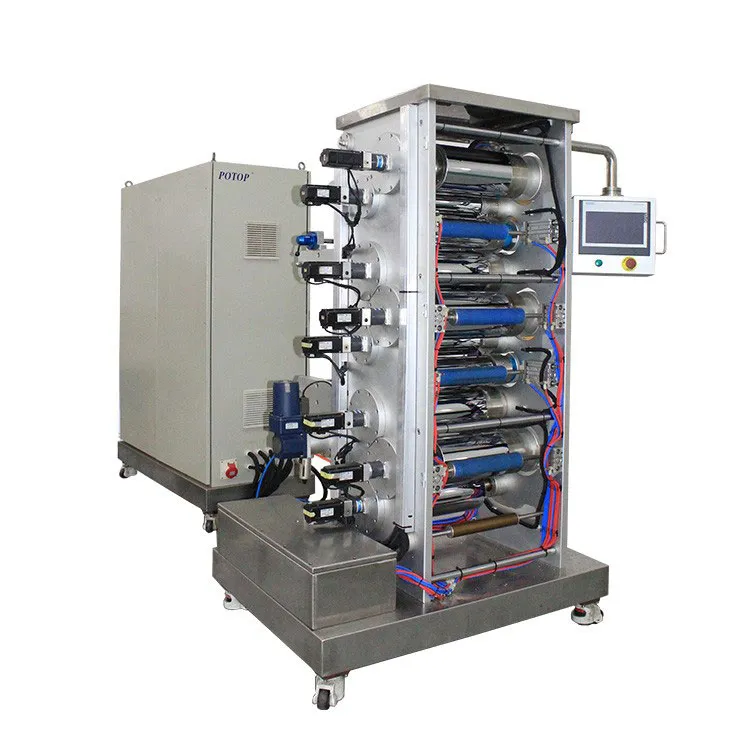
The POTOP Lab Small Desktop Sheet Extruder combines a single-screw extruder, flat die and precision roll-calendering section in a compact experimental line. The system is designed to produce controlled polymer sheet samples while recording the main extrusion and forming parameters.
The standard FPBL-35/30 configuration has a 30 mm screw diameter and an L/D ratio of 30. It supports screw speeds from 0 to 120 rpm and processing temperatures up to 350°C. The published configuration uses a 200 mm die lip and produces sheets up to 150 mm wide with a stated thickness range of 0.1 to 0.6 mm.
Independent servo drives control the extruder screw and forming rollers. This arrangement allows the screw speed, roller speed and line speed to be adjusted separately during process studies. The roller gap can also be changed continuously, making it possible to examine how roll temperature, draw ratio, cooling and compression affect the final sheet.
POTOP identifies PE, PP, PS, EVA, TPU and PC among the applicable materials. Optional constant-tension winding and specialized roller surfaces can support different experimental objectives. The system is particularly relevant to universities, research institutes and corporate laboratories developing new resins, functional sheets or processing parameters.
Because the equipment is designed for laboratory work, it should not be compared directly with large industrial sheet lines. Its main value lies in controlled experimentation, low-volume sample preparation, data acquisition and the ability to adjust process conditions before moving to pilot or production scale.
BREYER Maschinenfabrik is a German extrusion equipment manufacturer with a strong focus on high-quality sheet and film production. Its sheet extrusion systems cover clear sheet, light-guide panels, optical products and technical sheets for automotive, consumer goods and industrial applications.
The company’s sheet extrusion line portfolio includes the CrystalStar series for clear sheet, the BrightLine series for light-guide panels and the SolidStar series for technical sheet. These lines address applications where surface quality, transparency, thickness consistency and reproducible roll control are important.
BREYER works with materials such as ABS, ASA, TPU and various engineering plastics. Its systems may incorporate mono-layer or coextrusion arrangements, roll-gap control, interchangeable rolls, embossing, cutting, winding and stacking equipment.
This manufacturer is especially relevant when the finished sheet has demanding optical or surface requirements. Display components, transparent panels, automotive sheet and premium technical products normally require tighter control than general-purpose packaging sheet.
A purchasing team considering BREYER should define the required optical properties, surface finish, sheet dimensions and downstream converting process early in the project. These factors influence the die, polishing stack, roll finish, cooling arrangement and handling system.
SML is an Austrian manufacturer of extrusion lines for film, sheet, coating, laminating and multifilament applications. Its sheet equipment includes systems for PP, PS and barrier sheet used in thermoformed packaging.
The company develops complete production lines rather than only supplying the extruder. A typical project may include raw-material handling, extrusion, coextrusion, flat-die forming, polishing, thickness control, edge trimming, winding and the recovery of production scrap.
SML is particularly relevant to manufacturers producing sheet for cups, trays, containers and other thermoformed packaging. In these applications, a line must maintain stable gauge, surface quality and roll temperature while operating continuously at commercial speeds.
Barrier packaging creates additional process requirements. A multi-layer structure may combine structural polymers with barrier and adhesive layers. The extrusion system must control the output of each layer and maintain a stable layer distribution across the sheet width. For this reason, feedblock design, individual extruder control and online measurement are as important as the capacity of the main extruder.
SML is best considered for industrial packaging-sheet projects where continuous production, automated control and coordination with downstream thermoforming are major purchasing criteria.
Davis-Standard is an American extrusion equipment supplier serving sheet, film, coating, pipe, medical and other polymer-processing markets. Its sheet extrusion machinery covers laboratory development systems as well as complete commercial production lines.
The company supports flexible and rigid sheet made from materials including HIPS, PP, PET, PE, PMMA, ABS, PC and PETG. Its experience extends across thermoformed food packaging, appliance panels, electronics sheet, automotive applications, marine products, roofing membranes and medical or protective products.
Davis-Standard’s sheet systems can be configured for mono-layer or multi-layer production, including structures with as many as nine layers. Depending on the application, a line may use single or multiple extruders, coextrusion feedblocks, specialized dies, vertical or horizontal roll stands, inline scrap reprocessing and automated controls.
One advantage of this portfolio is the broad thickness range it addresses. Thin packaging sheet requires high line speed and efficient cooling, while heavy-gauge industrial products require different roll, pressure, cutting and material-handling arrangements. Davis-Standard supplies systems for both areas and also offers laboratory and pilot equipment for product validation.
The company is suitable for manufacturers seeking a customized production line supported by application engineering. A technical inquiry should clearly distinguish packaging sheet, optical sheet, heavy-gauge plate and coated membrane because each requires a different line architecture.
Gneuss is a German manufacturer of extrusion, filtration and measurement technology. Its sheet lines are particularly associated with PET processing and the conversion of recycled material into thermoforming sheet.
The company’s sheet extrusion systems are built around its processing and recycling technologies. These lines can manufacture PET sheet from post-consumer bottle flakes and other recycled feedstocks, depending on the required process and product compliance.
Recycled PET presents challenges that go beyond conventional extrusion. Moisture, contamination, viscosity variation and volatile components can affect sheet appearance and mechanical performance. Filtration, devolatilization and controlled melt processing therefore become central parts of the line.
Gneuss is a relevant candidate for companies planning food-packaging sheet, recycled-content sheet or direct recycling-to-sheet production. Its strength is not simply forming the sheet but managing melt quality before the material reaches the die and polishing stack.
During supplier evaluation, the incoming material condition should be defined carefully. The percentage of recycled content, flake quality, contamination level, moisture, required filtration fineness and final regulatory application all affect the proposed equipment.
Reifenhäuser is a German manufacturer of extrusion lines and components for film, sheet and nonwoven production. Its flat-film business includes the EVEREX range of cast-film and sheet extrusion systems.
The company’s EVEREX flat-film portfolio covers PP, PE, PET, PLA and barrier structures. Dedicated sheet solutions include PP and PS thermoforming sheet, PET sheet, barrier sheet, inline thermoforming configurations and special sheet for automotive or industrial applications.
Reifenhäuser places considerable emphasis on automation and reproducible product changes. Modern sheet lines may integrate automated coextrusion adjustment, die control, thickness management, roll-stack operation and winding. These functions can reduce the dependence of sheet quality on manual adjustments during startup and product changeovers.
The EVEREX Sheet Inline concept is designed to connect sheet extrusion directly with thermoforming. Retaining heat in the sheet between the two processes can improve energy use and eliminate some of the handling required in a separate sheet-production stage.
Reifenhäuser is most relevant to established packaging and industrial manufacturers planning high-output, automated lines. The purchasing assessment should consider the complete workflow from resin feeding to thermoforming or winding rather than treating the extruder as a standalone machine.
KraussMaffei supplies extrusion equipment for compounding, pipe, profile, foam, rubber and flat-product manufacturing. Its flat extrusion solutions can combine single-screw or twin-screw extrusion technology with shaping and downstream components.
The company’s broad equipment portfolio makes it suitable for process-specific industrial projects. A sheet line can be developed around the behavior of the raw material and the required finished product instead of starting from one standard machine configuration.
Twin-screw processing may be useful when compounding, devolatilization or high filler loading must occur directly before sheet formation. Single-screw extrusion may remain the more appropriate option for stable, pre-compounded resins. KraussMaffei can address both processing routes within its extrusion portfolio.
This flexibility is relevant to technical sheet, filled products, recycled materials and production lines requiring coordination between material preparation and sheet forming. It also means that the technical proposal must be evaluated in detail. Screw technology, die design, forming method, control system and downstream handling should all correspond to the same process objective.
KraussMaffei is best suited to industrial manufacturers requiring engineering support for a complete or technically specialized production system.
OMIPA is an Italian manufacturer specializing in complete extrusion and coextrusion lines. Its portfolio includes hollow polycarbonate panels, PP hollow profiles, film, foil, foam, optical sheet and technical thermoforming sheet.
The company’s technical and thermoforming sheet systems serve packaging and industrial applications, while its optical-sheet equipment addresses products where transparency and surface consistency are critical. Supported product categories include sheets based on PET, PP, PS, PLA, ABS, HIPS, PMMA, PC and multi-material structures.
OMIPA performs design and production activities in-house and supplies complete lines rather than isolated processing units. Its systems can incorporate extrusion, coextrusion, calibration, polishing, cutting, stacking and winding according to the finished product.
The breadth of the company’s sheet portfolio makes it relevant to manufacturers with a clearly defined specialty product. A thermoforming packaging line, a transparent PMMA sheet line and a polycarbonate hollow-panel line are all flat extrusion projects, but they require very different dies, calibrators, cooling systems and handling equipment.
OMIPA should therefore be evaluated according to experience with the exact product category rather than extrusion equipment in general.
JWELL is a Chinese manufacturer of extrusion machinery with a broad range of sheet, plate and film extrusion lines. Its sheet equipment covers PET, PP, PS, PVC, ABS, HIPS, PLA, TPU and other thermoplastic materials.
The product range includes PET and PETG sheet machines, PP and PS thermoforming sheet lines, PVC transparent sheet equipment, ABS and HIPS blister-sheet lines, refrigerator-board lines and systems for degradable or specialty materials.
This range makes JWELL a practical candidate for commercial manufacturers looking for different output levels and line configurations from a Chinese supplier. The company can combine extrusion equipment with dies, forming rolls, cooling, trimming, winding, stacking and other downstream machinery.
Because JWELL offers many models and application categories, the technical comparison should be based on the proposed configuration rather than the company’s general catalogue. The extruder diameter, motor power, die width, roller design, thickness tolerance, automation level and actual output with the specified polymer should be confirmed in the quotation.
A factory acceptance test using the intended material is particularly valuable when purchasing a complete production line. It allows the buyer to evaluate sheet thickness, width, surface quality, output and line stability under conditions that resemble the planned application.
USEON is a Chinese manufacturer of twin-screw extrusion, compounding, recycling and direct-extrusion systems. Its approach to sheet production is particularly relevant when material compounding and sheet formation need to occur in one continuous process.
A conventional route may first compound polymer, filler and additives into pellets. The pellets are then cooled, transported, dried if necessary and melted again in a sheet extruder. USEON’s sheet direct extrusion line can combine mixing, devolatilization and sheet production without an intermediate pelletizing stage.
The company applies this approach to materials and products including filled PP sheet, wood-plastic sheet, HDPE waterproof sheet, PET sheet, ABS sheet, barrier structures and solar encapsulation films. Direct extrusion can be especially useful for formulations containing fillers, fibers, recycled material or components that require mixing immediately before sheet formation.
This process is not automatically appropriate for every sheet. Stable, pre-compounded materials may be processed more simply with a conventional single-screw system. Direct extrusion becomes more attractive when eliminating a separate compounding and pelletizing stage provides a clear process or energy advantage.
USEON is best suited to production projects in which formulation, feeding, compounding and sheet formation must be engineered as one system.
Plastic sheet extrusion equipment is usually defined by the finished product rather than by the extruder alone. Thin thermoforming sheet for food packaging, transparent optical sheet and heavy automotive plate are all manufactured through flat extrusion, but their processing conditions differ substantially.
Packaging sheet lines usually prioritize output, thickness consistency, cooling efficiency and compatibility with thermoforming. PET, PP and PS are common materials. When barrier properties are required, several extruders may feed a coextrusion block to create structural, adhesive and barrier layers.
Optical and transparent sheet requires close control of melt homogeneity, contamination, die flow, roll condition and cooling. Small defects that are acceptable in an industrial backing panel may be unacceptable in a light-guide plate or transparent display component.
Technical and heavy-gauge sheet places greater emphasis on stiffness, surface texture, width, dimensional stability and material handling. ABS, HIPS, HDPE, PP, PMMA and engineering plastics may be processed into automotive panels, appliance liners, construction products and industrial components.
Laboratory sheet extruders serve a different purpose. They allow researchers to prepare samples and study how polymer composition, temperature, screw speed, roller gap and cooling affect the finished sheet. Low material consumption, flexible controls and access for cleaning are generally more important than commercial output.
The comparison should begin with the product specification. The manufacturer needs to know the polymer, material form, recycled content, number of layers, sheet width, thickness range, surface finish, target output and downstream converting method. A machine recommendation made without these inputs is unlikely to be reliable.
Extruder selection comes next. Single-screw machines are widely used for stable, pre-compounded materials, while twin-screw systems may be selected when the process requires mixing, devolatilization, direct recycling or high filler incorporation. Coextrusion requires additional extruders and accurate control of each layer.
The flat die and roll stack have a direct influence on sheet quality. Die design affects material distribution across the width, while roll temperature, gap, pressure and speed determine cooling, surface finish and final thickness. Optical sheet, embossed products and thin thermoforming sheet may each require a different roll arrangement.
Online measurement should also be reviewed. A production line may use thickness scanning, automatic die adjustment and closed-loop control to reduce gauge variation. Laboratory machines may instead prioritize real-time display of temperature, pressure, screw speed and line speed so researchers can compare experimental conditions.
Downstream equipment depends on whether the sheet will be wound, cut, stacked or transferred directly into a thermoforming machine. Edge trimming, scrap grinding and material return should be included in the production analysis because they affect material efficiency and line stability.
Service capability is the final part of the evaluation. Installation, commissioning, operator training, spare parts, remote diagnostics and process support can have a greater effect on long-term output than a small difference in the original purchase price.
A useful request for quotation should describe the planned product rather than asking only for a “plastic sheet machine.” The supplier should receive the polymer grade or full formulation, expected recycled content, target sheet width and thickness, number of layers, required surface finish, hourly output and final application.
The inquiry should also explain whether the sheet will be wound, cut, stacked or sent directly to a thermoformer. Available electricity, cooling water, compressed air, floor space and local safety requirements should be included because these conditions influence the line design.
For a new or difficult material, the request should include a material trial. The test should document the actual formulation, temperature profile, screw speed, melt pressure, line speed, roller conditions and measured sheet results. A demonstration using an unrelated resin provides limited evidence that the proposed line will meet the project requirements.
A plastic sheet extrusion machine melts a thermoplastic material and passes it through a flat die. The hot material is then cooled and shaped by a roll stack or calender to produce a continuous sheet. The complete line may also include dosing, coextrusion, thickness measurement, edge trimming, winding, cutting, stacking and scrap recycling.
Manufacturers serving this market include POTOP, BREYER, SML, Davis-Standard, Gneuss, Reifenhäuser, KraussMaffei, OMIPA, JWELL and USEON. Some specialize in laboratory systems, while others focus on commercial packaging, optical, technical or recycled-material sheet lines.
There is no single manufacturer that is best for every application. POTOP is particularly relevant to laboratory sample preparation and process research. BREYER and OMIPA have strong specialty-sheet portfolios. SML and Reifenhäuser focus on commercial packaging and flat-film systems. Davis-Standard provides a broad range from laboratory to heavy-gauge sheet, while Gneuss is especially relevant to recycled PET processing. JWELL and USEON offer a wide range of industrial systems from China.
The final choice should be based on successful processing of the intended material and the supplier’s ability to meet the required width, thickness, output and product-quality targets.
Common materials include PET, PETG, PP, PS, PE, HDPE, ABS, HIPS, PVC, PMMA, PC, TPU, EVA and PLA. However, a line designed for one polymer may not process another material effectively without changes to the screw, drying system, temperature range, die and cooling arrangement.
Both processes use a flat die and cooled rollers. The distinction commonly depends on product thickness, flexibility and application, but there is no single universal thickness boundary. Sheet is generally more rigid and is often cut, stacked or thermoformed. Cast film is generally thinner and is normally wound into rolls.
A sheet line can normally operate across a specified thickness range, but the achievable range depends on die opening, roll-stack design, line speed, cooling capacity and material behavior. A machine optimized for very thin packaging sheet may not be suitable for heavy plate, even if both products use the same polymer.
Coextrusion is required when the finished sheet contains two or more functional layers. These layers may provide stiffness, color, recycled content, adhesion, sealing performance or gas and moisture barriers. Each material stream must be controlled so that the layer distribution remains stable across the width of the sheet.
Single-screw extruders are widely used when the material has already been compounded and requires stable melting and pressure generation. Twin-screw extruders may be more suitable when mixing, reactive processing, filler dispersion, recycling or devolatilization must occur during sheet production.
The decision should be based on the formulation and process requirements rather than the assumption that one screw design is always superior.
Laboratory equipment should be assessed by sample consumption, sheet dimensions, temperature range, screw-speed control, roll-gap adjustment, data collection and ease of cleaning. The machine should also reproduce the process variables that are important for later scale-up, even though laboratory output will be much lower than industrial production.
The price depends on equipment scale, output, sheet width, number of layers, extruder configuration, die technology, roll stack, thickness control and downstream automation. A compact laboratory system and a complete industrial coextrusion line belong to entirely different investment categories.
A meaningful quotation can only be prepared after the product and process requirements have been defined.
The plastic sheet extrusion machine manufacturers in this guide serve different sections of the market. Some focus on laboratory material development, while others build complete industrial lines for packaging, optical sheet, recycled PET, technical panels or direct extrusion.
Procurement teams should avoid comparing these companies only by maximum output or equipment price. The more important question is whether the proposed line can process the specified material and consistently produce the required sheet width, thickness, surface quality and layer structure.
For laboratory research and small-scale process development, the POTOP Lab Small Desktop Sheet Extruder provides independently controlled extrusion and roll-forming functions in a compact system. It is designed for polymer sheet preparation, calendering studies and the evaluation of new materials before pilot or commercial production.
Research institutes and material manufacturers can contact POTOP with the polymer type, required sheet dimensions, processing temperature and experimental objectives to discuss a suitable laboratory sheet extrusion configuration.